




Iron Ore
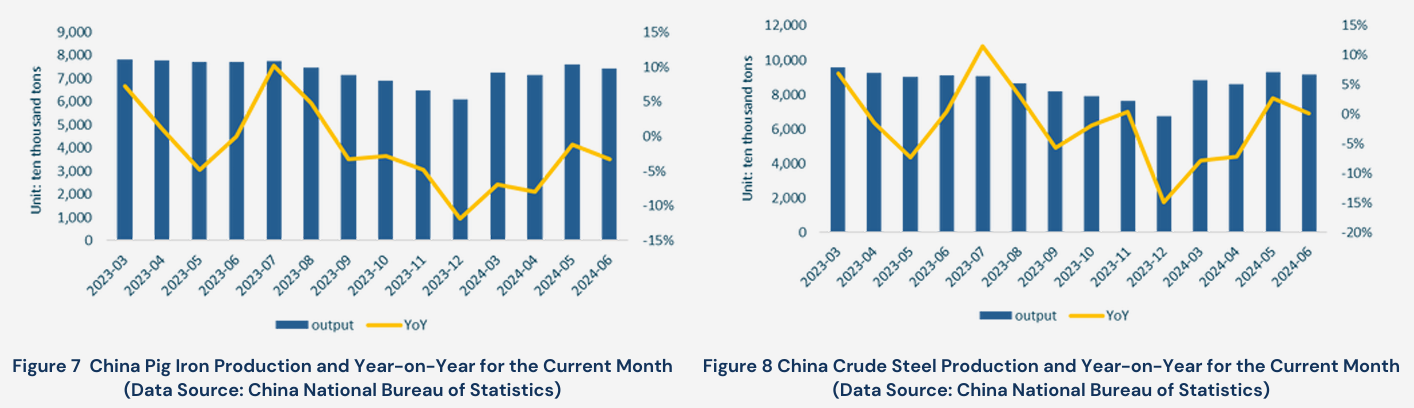
In the first half of 2024, the iron ore market witnessed an oversupply amid tepid demand. On the supply side, global iron ore shipments remained largely on par with the previous year, with an increased proportion destined for China, resulting in a slight rise in the country's overall iron ore supply. On the demand side, pig iron demand and crude steel output were relatively subdued compared to the same period last year. Data reveals a year-on-year decline in China's pig iron production and crude steel output. China's Policy documents released during the first half of the year focused on providing guidance for regulating steel production, and it is anticipated that policy factors will impact market sentiment and fourth-quarter output levels. Looking ahead to the latter half of the year, the oversupply and weak demand dynamics in the iron ore market are expected to persist, potentially exerting further downward pressure on iron ore prices amid fluctuations.
Coal
In the first six months, the coal market was primarily influenced by lackluster domestic demand in China, leading to a downward trend in prices. The Bohai-Rim Steam Coal Price Index (BSPI) exhibited an overall pattern of bottoming out and rebounding. From January to June, the restoration of water inflows in the Yangtze River Basin allowed for increased hydroelectric generation, displacing thermal power and resulting in a relative shortfall in coal demand. In the Chinese domestic coal trade, both shipment and unloading volumes declined. Notably, in the seaborne coal trade, China's total coal imports increased against the backdrop of a year-on-year decrease in global seaborne shipments. Looking ahead to the second half of the year, the coal market might continue to exhibit weak supply and demand dynamics, potentially leading to a bearish, slightly declining price trend amid fluctuations.
Weak domestic demand in China emerged as a common characteristic of major bulk commodity markets, exemplified by coal and iron ore, in the first half of 2024. On the supply side, iron ore arrivals and unloading volumes remained elevated, indicative of an oversupply scenario, while the coal market experienced a dual supply-demand weakness, resulting in price declines for both commodities by mid-2024.
Iron Ore
In the first half of the year, China imported iron ore prices exhibited a pattern of decline, followed by a rebound and subsequent decline, influenced by both supply and demand factors.
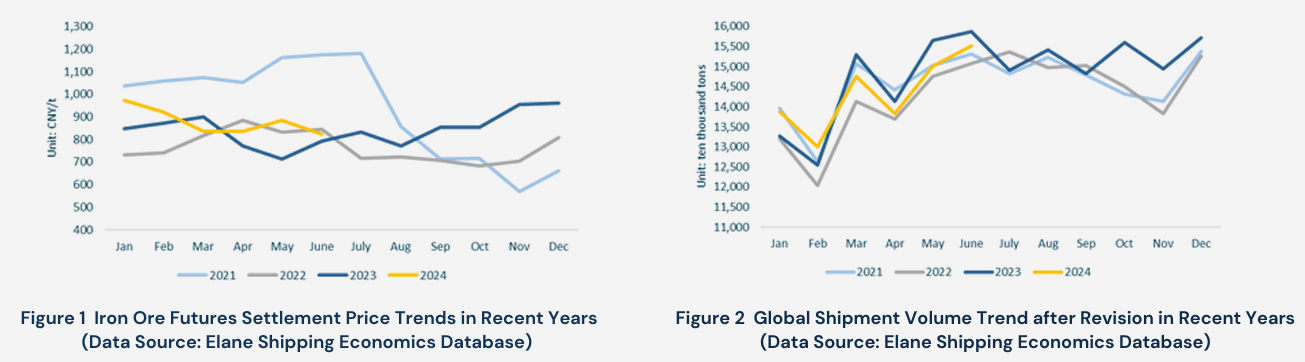
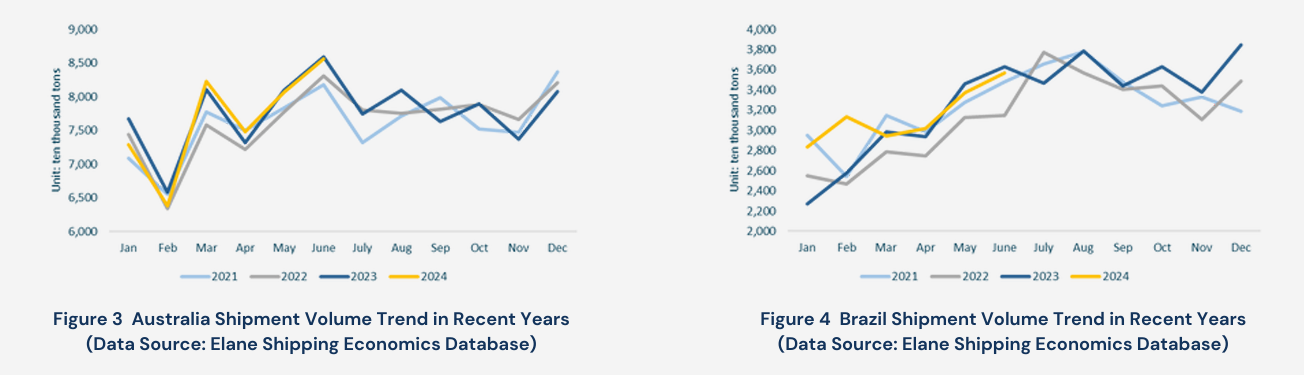
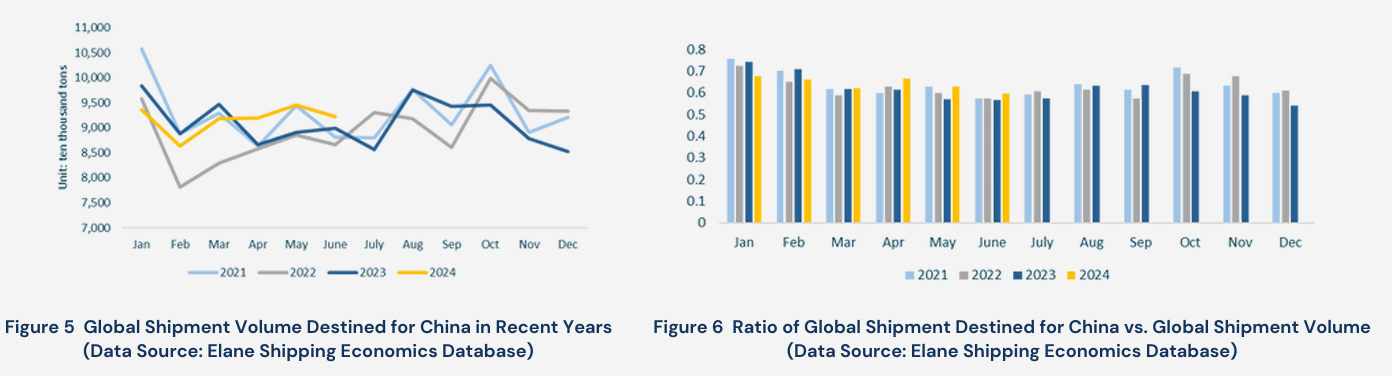
On the supply side, global iron ore shipments totaled 860.1 million tons in the first half of 2024, a year-on-year decrease of 0.86%, largely on par with the previous year. However, the proportion destined for China increased from 63.65% to 64.16% compared with last year, leading to a slight rise in overall supply. Examining country-specific data, Australia shipped 460.09 million tons, a 0.77% year-on-year decrease, remaining essentially flat compared to the previous year. Brazil shipped 188.71 million tons, a notable 5.66% year-on-year increase. Globally, the total unloading volume destined for China reached 550.55 million tons, a 0.52% year-on-year increase.
On the demand side, pig iron demand and crude steel output were relatively subdued compared to the same period last year. According to data released by the China National Bureau of Statistics, China's pig iron production from March to June 2024 totaled 294.91 million tons, a 4.83% year-on-year decrease. During the same period, crude steel output totaled 358.68 million tons, a 2.95% year-on-year decrease.
Regarding policy factors, the 2024-25 Energy Conservation and Carbon Reduction Action Plan issued by China on May 29th provided general guidance for regulating steel production in 2024 2025. Several provinces in China responded by successively releasing targeted objectives and work arrangements for crude steel output control in 2024, including Shandong, Jiangsu, Hebei, and Fujian. On June 7th, the China National Development and Reform Commission, along with four other ministries, jointly formulated and issued the Special Action Plan for Energy Conservation and Carbon Reduction in the Steel Industry, also calling for continued crude steel output regulation in 2024. It is anticipated that policy factors will impact market sentiment and fourth-quarter production levels.
Looking ahead to the second half of the year, the oversupply and weak demand dynamics in the iron ore market are expected to persist, potentially exerting further downward pressure on iron ore prices amid fluctuations.
Coal
In the first half of 2024, the coal market was primarily influenced by lackluster China domestic demand, leading to a downward trend in prices. The Bohai-Rim Steam Coal Price Index (BSPI) exhibited an overall pattern of bottoming out and rebounding, with an average of 721.58 points in the first half of the year, a 1.09% year-on-year decrease.
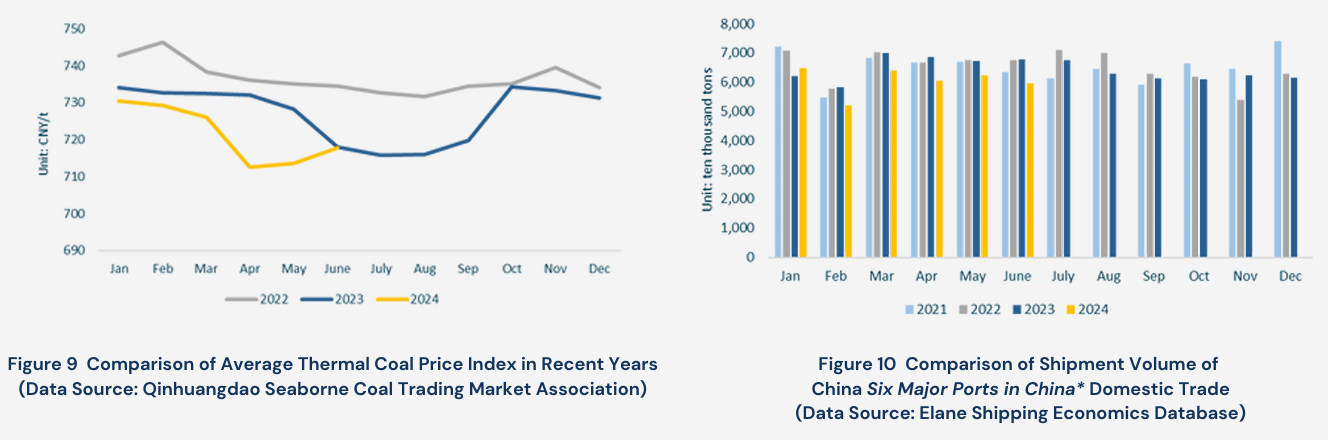
From January to June, the restoration of water inflows in the Yangtze River Basin allowed for increased hydroelectric generation, displacing thermal power and resulting in a relative shortfall in coal demand. According to data from the China National Bureau of Statistics, China's power generation by industrial enterprises above a designated size reached 4.4 trillion kilowatt hours in the first half of 2024, a 5.2% year-on-year increase. Specifically, hydroelectric power generation increased by 21.4%, while thermal power generation rose by only 1.7%.
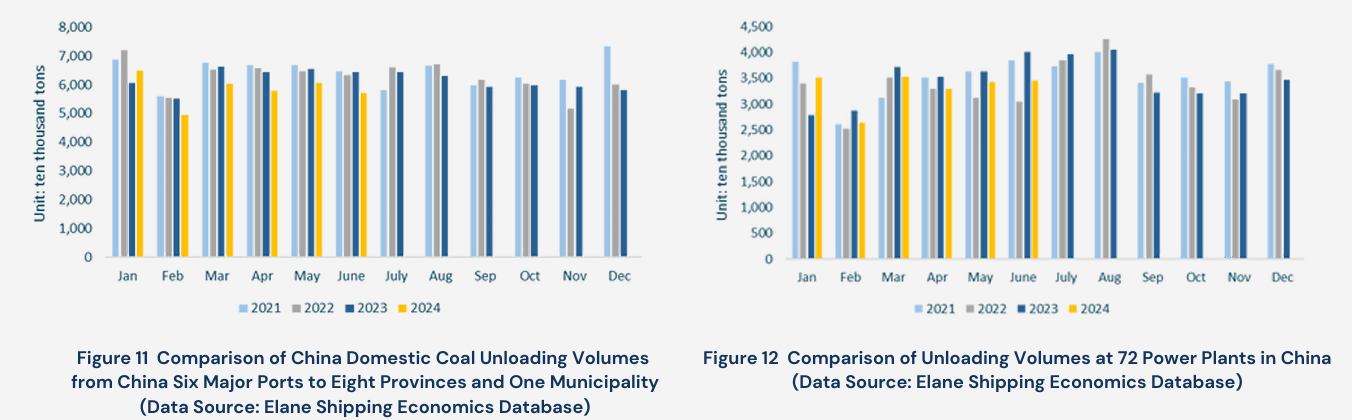
In China domestic coal trade, both shipment and unloading volumes declined. In the first half of the year, the total shipment volume from China Six Major Ports reached 363.16 million tons, a 7.84% year-on-year decrease. The total unloading volume for China Six Major Ports destined for Eight Provinces and One Municipality in China (typically including the provinces of Liaoning, Shandong, Jiangsu, Zhejiang, Fujian, Guangdong, Guangxi, Hainan, and the municipality of Shanghai). was 350.61 million tons, a 6.87% year-on-year decrease. The total unloading volume for 72 power plants was 221.44 million tons, a 1.31% year-on-year increase, though the growth rate was lower than the same period last year.
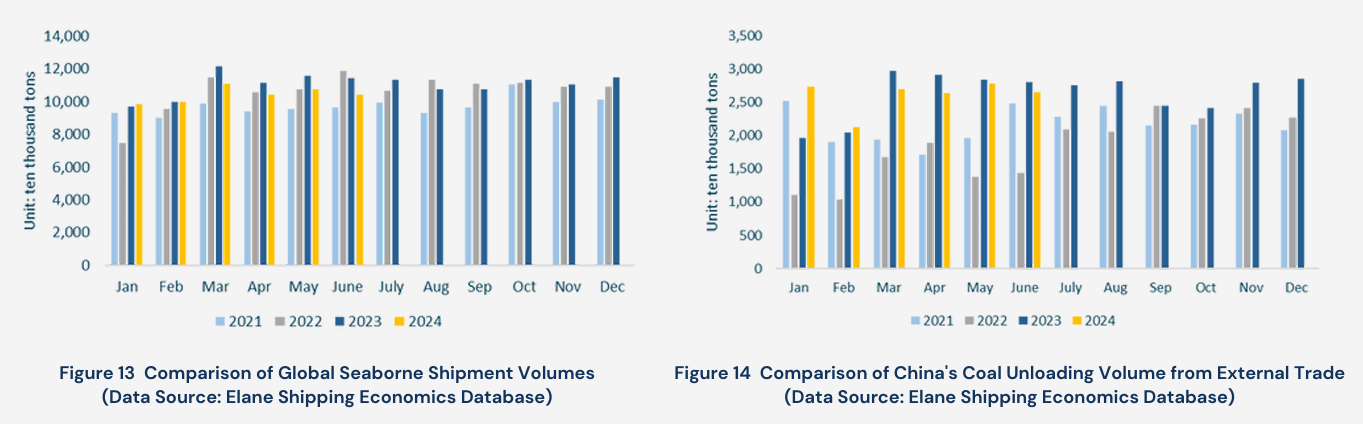
In the seaborne coal trade, China's total coal imports increased in the first half of 2024. During the same period, global seaborne shipments totaled 625.11 million tons, a 5.38% year-on-year decrease. Despite this backdrop, China's coal unloading volume from external trade reached 156.43 million tons, a 0.76% year-on-year increase.
Looking ahead to the second half of the year, the coal market might continue to exhibit weak supply and demand dynamics, potentially emerging from the trend of bearish, slightly price declining amid fluctuations.
Note*
China Six Major Ports typically include Jingtang Port, Caofeidian Port, Tianjin Port, Huanghua Port, Qinhuangdao Port, and Rizhao Port
As an independent third party, we track and record in real-time the circulation of every port, every ship, every cargo of crude oil, natural gas, coal, iron ore, grain, and containers globally. This data provides reliable evidence and innovative perspectives for the operational and investment decisions of industry-leading enterprises, ultimately forming a competitive advantage.